


10
2025
-
07
Truck Encyclopedia (3): Bulb interface, you can understand it at a glance
Lao Wang bought a new truck and started to run transportation, but when he ran at night, he always felt that the lights were dim and the road could not be seen clearly, which was not only unsafe, but also tired eyes. Thinking that there are brighter versions of the bulbs on the Internet, replacing them with a few greatly improves safety, not to mention, eye fatigue can also be greatly reduced.

But after checking the Internet, Lao Wang was confused, what is going on. As a result, Lao Wang checked the car headlight bulbs, and there were more than N models, what H1, H3, H7, D1S, D2S, etc...... Seeing that Lao Wang was stunned. Today, this article will popularize some bulb models in car headlights.

Car bulbs are divided into different interfaces according to different lighting needs. According to the bright function, it can be divided into wide indicators, turn signals, fog lights, low beams, high beams, reversing lights, license plate lights and daytime running lights, etc., which we will introduce one by one below.
▎ Marker light
Marker lights, also known as wide lights, are mainly used to remind other vehicles to pay attention to them in the case of low visibility. In haze weather, driving in the evening, and in rainy days, you can turn on the light separately to facilitate the identification of pedestrians and other vehicles.
 T20和其他锲型灯泡一样为平口双触接口 There is no positive or negative
The common interfaces of marker lamps are: T5, T10 (W5W), T15 (W16W) and T20 (W21W), etc., this kind of bulb is also called wedge bulb, commonly known as plug bubble, the larger its number, the larger the volume wattage. For example, the wattage of the T10 (W5W) is 5W. But this wattage is not absolute, according to experience, the current T10 halogen lamp is mostly 5W, but the T10 LED wattage is only about 0.5-2W.
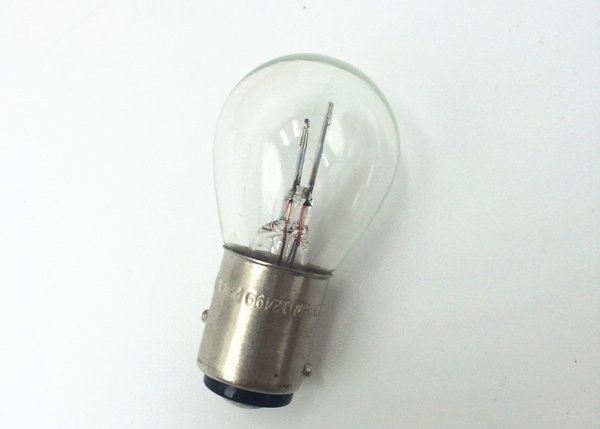 P21/5W为双灯丝 双触点 外缘有一高一低2external teeth
In addition, there are some wide indicator light interfaces that are mostly used in tail lights: P21/5W model. P21/5W is a double-filament bulb, that is, there are 2 tungsten wires in the bulb, the interface is a circular double contact, and there are two external teeth on the outer edge, one high and one low, commonly known as high and low feet.
The P21/5W marker lamp at the rear of the car also functions as a brake light. The two filaments in the bulb are one for the marker light and the other for the brake light, which work independently and do not interfere with each other.
▎Low beam/high beam (halogen)
Both types of lights are indispensable as essential lights for driving at night, and the low beam has a cut-off line for well-regulated lighting or illumination at low speeds. The high beams are generally turned on when driving on highways and in places where there are no street lights in the suburbs to expand the field of vision. However, for the sake of safety and courtesy, it is necessary to switch to low beam.
Common interface forms for halogen low beam/high beam include H1, H4, H7, etc. As the main lighting, the wattage of the bulbs with different interfaces is mostly about 70W, and the wattage of the brightened headlights can reach 100-130W. The front light bulb of passenger cars is only about 50-60W.
Here I need to remind you that the wattage of some brightening bulbs is as high as 130W, which is really powerful for improving brightness, but after long-term use, the high temperature will cause the reflector inside the headlamp to burn yellow, and even melt the lampshade, it is not recommended to blindly choose a high wattage bulb.
The H1 connector is a single pin contact with no snap teeth in the base
The H4 connector is a three-pin contact with two teeth in the base
The H7 connector is a two-pin contact with a clamp on the base
▎Low/High Beam (Xenon)
As a configuration for high-end trucks, xenon (pinyin: xian) gas headlights still have a place. Personally, I also prefer this kind of bulb that relies on 23,000 volts to make arc light, compared with the increasingly popular LED headlights, xenon lamps have the characteristics of good color rendering, natural color temperature, and lower eye fatigue when driving at night.
However, due to the unique working principle of xenon lamps, they need to be equipped with a separate ballast before they can be used.
The operating voltage of the xenon lamp is 23000V, and the power is 35-45W.
There are four common interface forms for xenon lamps: D1S, D2S, D3S, and D4S.
 D1S and D3S are equipped with ballasts and the interface is square
 D2S and D4S do not have ballast, and are circular interfaces
▎Fog lights, turn signals, brake lights, reversing lights
The common interfaces of fog lights, turn signals, brake lights and reversing lights are: H8, P21W, PY21W, T20, etc.
The H3 connector is a single cable pin contact with no snap teeth in the base
The H3 is mainly used for truck front fog lamps and has a power of 70W.
P21W and PY21W are mainly used for brake lights, turn signals, reversing lights and rear fog lights, all of which are circular single-contact interfaces, with a power of 21W, and of course there are many brightening types with 35W or even greater wattage.
 P21W is a single filament single contact
The only difference between P21W and PY21W is that the two external teeth of P21W are distributed at 180°, while the two external teeth of PY21W are distributed at 150°.
▎Daytime running lights

Daytime running lights originated in Northern Europe in the 90s of the last century. Due to the high latitude, climate, mountainous terrain, fog and other phenomena of poor visibility often occur, it is easy to cause traffic accidents and casualties. Therefore, the local government requires that no matter day or night, the driving vehicle must turn on the headlights, and if the lights are not turned on, there will be a high fine, which is the earliest daytime running lights.
The current daytime running lights mostly use LED light sources, which are generally integrated inside the headlights or independent of the bumper, and there is no fixed special interface, and the later installation is basically installed through separate wiring, so there is no fixed interface.
▎LED
Finally, I would like to mention the light bulb of the LED. LED is a light-emitting diode, and compared with traditional lamps, LED lamps have the advantages of energy saving and good response speed.
Energy saving is the most prominent feature of LED lamps, and the energy consumption of LED lamps is about one-tenth of that of halogen lamps.
In addition, LEDs are extremely responsive and turn on faster than halogen bulbs when powered on. It is used in brake lights to improve safety and provide more reaction time for the driver behind them.
A "mountain" shaped heat sink on the T20 LED
But LEDs also have certain disadvantages, that is, they are afraid of heat. LED is a cold light source, but the lamp body itself generates a large amount of heat, and it needs to be used stably with a certain heat dissipation design during manufacturing.
Previous Page

Focus on the research and development of automotive brake systems and pneumatic brake valves to promote the development of the auto parts industry!
Contact Information
Telephone:86-575-87438928
Mobile:8613252110178
QQ:1185450863@qq.com
Address: No. 461, Advanced Village, Fengqiao Town, Zhuji, Zhejiang Province
Online message
Submit your information and we will contact you as soon as possible.