


06
2025
-
12
Air leak in light truck air brake lines? Quickly check if it has these 4 features

In the past one or two years, a common feature we've noticed in light trucks is that they are starting to be equipped with air brakes. As light trucks carry heavier loads, the traditional oil brakes that were standard on them can no longer meet braking demands. On the other hand, in terms of braking safety, it is generally believed that air brakes provide stronger braking force than oil brakes, so many users also tend to choose light trucks with air brakes.
However, when major manufacturers quickly transplant the air brake technology from heavy trucks to light trucks, it has also brought issues of air brake line leaks to light trucks, especially in early models, where air brake line leaks are particularly common. According to drivers of light trucks with air brakes, leaks in the brake air system usually occur at the connections of various lines and at locations where the lines are prone to friction.
▎Multiple factors cause leaks, experienced drivers have their own ways to check them

There are many reasons for air leaks in light truck air brake lines, but the two most common factors are as follows: First, rust in the air brake system's air tanks and pipelines. High-pressure, high-speed airflow can cause rust to flake off, and the fast-moving air can carry the rust through the pipe joints, damaging the sealing rings and causing leaks. Second, leaks at various connectors. A complete air brake system can have up to hundreds of connectors. Generally, ordinary connectors are used, which are sealed by tightening the threads and adding sealing tape. Initially, tightening once or twice may not cause a leak, but after multiple removals, the sealing performance deteriorates, increasing the likelihood of leaks.
So, how can air brake line leaks be quickly located? According to some experienced drivers, there are generally two common methods: one is to listen with your ears—when the leak is severe, you can roughly locate the leak by sound; the other is to apply foaming solution, which accurately identifies the leak point. Most drivers prefer foaming solution: applying a bit of foam to the suspected leak area can usually confirm whether there is a leak. Once the leak point is found, parts can be replaced or repaired. However, fixing leaks this way repeatedly is not a sustainable solution.
▎Address the root cause rather than just the symptoms: Four key configurations to reduce air leaks
Air brake system leaks and frequent loss of pressure in the air reservoir are issues that trouble many drivers. So what configurations can help reduce the chances of air leaks?
1. Air dryer

When light trucks first started being equipped with air brakes, there were not many models with dryers, which caused water to easily accumulate in the brake lines of early models. Ordinary iron air tanks were very prone to rust, and the flaking rust could damage the sealing gaskets. With technological development, the air brake systems on light trucks have also been gradually optimized. Nowadays, many models come standard with dryers, which help to absorb moisture in the air lines.
2. Cooling pipes

As we all know, when air is compressed, its temperature rises, and water in liquid form will evaporate into gas. This means that the water vapor cannot be completely absorbed when passing through the dryer, and after reaching the air storage tank, it will cool down and turn back into liquid, still storing in the air tank. Therefore, a cooling line can be added to cool down the compressed air before it enters the dryer, allowing the vapor to condense into liquid and pass through the dryer, removing as much moisture from the compressed air as possible. This setup is widely used in heavy trucks, but is less commonly used in light trucks.
3. Aluminum alloy air storage tank
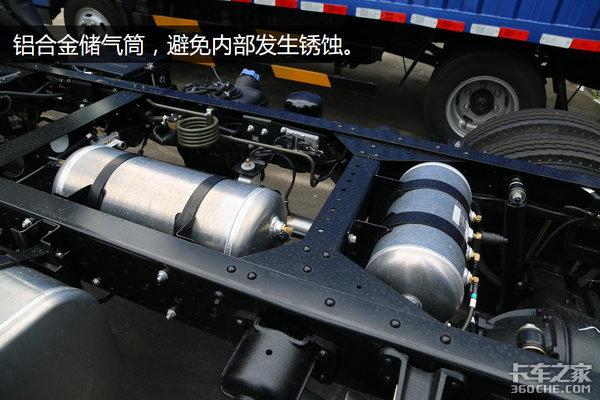
The most direct way to prevent the air tank from rusting is still to replace it with an aluminum air tank to prevent corrosion. Just make sure to drain the water regularly.
4. Quick-connect fittings

In the past, light trucks used ordinary connectors, which required wrapping sealing tape around the interface and then tightening it to achieve a seal. However, this sealing method could not withstand multiple disassemblies. Each time it was disassembled, more sealing tape was needed and it had to be tightened even more. After several times, the sealing performance would start to deteriorate. To improve this flaw, some light trucks have started to be equipped with quick-connect interfaces that can rotate in all directions and come with double layers of sealing rings, providing good sealing performance that remains effective even after multiple disassemblies.
Air leaks in the piping are truly troublesome. They cause the pressure in the air storage tank to remain consistently low, leading to prolonged operation of the air pump, which increases engine load and wears out the air pump, resulting in higher fuel consumption and maintenance costs. Additionally, it requires considerable time for inspections and repairs. However, with the updating of vehicle models, the technology is becoming increasingly mature, and the issue of leaks in air brake systems is expected to be resolved accordingly. If any truckers have better solutions for handling air brake leaks in light trucks, you are welcome to share them in the comments.

Focus on the research and development of automotive brake systems and pneumatic brake valves to promote the development of the auto parts industry!
Contact Information
Telephone:86-575-87438928
Mobile:8613252110178
QQ:1185450863@qq.com
Address: No. 461, Advanced Village, Fengqiao Town, Zhuji, Zhejiang Province
Online message
Submit your information and we will contact you as soon as possible.