


21
2026
-
04
Analysis of Verification Test on Exhaust Brake Characteristics of Commercial Vehicles
As a type of auxiliary brake for commercial vehicles, the exhaust brake offers economic efficiency, reliability, and practicality that other auxiliary brakes cannot match, commonly referred to as the vehicle's third brake. Proper use of the exhaust brake can significantly reduce the use of the service brakes, thereby reducing brake pad wear and greatly lowering the risk to driving safety caused by brake pads overheating from continuous braking. Therefore, one should understand the characteristics of the exhaust brake along with its operating principles to better utilize this function. This article takes three vehicles equipped with exhaust brakes as the test subjects, using a full vehicle chassis dynamometer to obtain data on the vehicle during normal coasting in gear and coasting with the exhaust brake engaged for calculation and analysis, providing a reference for the correct use of the exhaust brake.
Principle of the Exhaust Brake
The exhaust brake works by adding an exhaust brake valve between the engine exhaust manifold and the muffler. This valve can adjust its angle according to the piston position in the cylinder, partially closing the engine exhaust pipe to different extents. As a result, during the compression and exhaust strokes, the engine pistons face increased resistance due to the backpressure in the exhaust and within the engine. This resistance is then transmitted through the crankshaft, flywheel, and the vehicle's entire drivetrain to the drive wheels, thus reducing the vehicle's speed. The cylinder is driven by the vehicle's compressed air. Compressed air from the vehicle enters the cylinder through the solenoid valve air joint, and the solenoid valve controls the air volume to adjust the valve opening (see Figure 1).

Advantages of Exhaust Braking
From the above principle of exhaust braking, we understand that exhaust braking achieves vehicle braking by increasing the resistance during the movement of the engine pistons. The braking process goes through the vehicle's transmission system, from the engine flywheel to the gearbox, driveshaft, reducer, and wheels. When the exhaust brake is activated, the vehicle can decelerate without pressing the brake pedal, significantly reducing the wear of the brake pads and decreasing the risk of brake failure caused by excessive wear or overheating of the brake pads. The following experiments aim to investigate this issue.
Verifying the Efficiency of Exhaust Braking through Experiments
3.1 Experimental Design
By conducting gear-engaged coasting tests on vehicles equipped with exhaust brakes on a full vehicle chassis dynamometer, firstly, the tire pressure is adjusted to the values recommended by the vehicle manufacturer. During the experiment, coasting tests are conducted three times for both conditions: with the engine exhaust brake engaged and disengaged. The vehicle speed and time are measured during the deceleration from 50 km/h to 30 km/h and from 30 km/h to 15 km/h, analyzing the braking effect when the exhaust brake is activated. Gear positions are selected based on normal driving habits of the vehicle during the test.
3.2 Test Subjects
In this test, three mainstream domestic vehicle models equipped with engine exhaust brakes were randomly selected. The three vehicles have different tonnage and engine power ranges and are tested on a full vehicle chassis dynamometer. The chassis dynamometer is produced by the American company Parker. Detailed information about the test subjects is shown in Table 1.

3.3 Test Procedure
3.3.1 Determination of Road Resistance Coefficients for Three Vehicles
The first and second vehicles use industry-recommended rolling resistance coefficient tests, while the third vehicle uses the actual road rolling resistance coefficient. The resistance coefficient represents the resistance experienced by a fully loaded vehicle in motion, including aerodynamic drag, tire rolling resistance, and internal vehicle resistance. The calculation formula is:
F = A + Bv + Cv²
3.3.2 Test Preparation
Fix the vehicles on a chassis dynamometer, set the corresponding resistance coefficients, and preheat the vehicles for 30 minutes. The resistance coefficients for the three vehicles are shown in Table 2.

3.3.3 Test Procedure
According to normal vehicle driving conditions, turn the engine exhaust brake off and on, accelerate the vehicle to 50 km/h, then, with the gear engaged, completely release the accelerator pedal, recording the time at each 1 km/h speed decrement until the vehicle speed is less than 30 km/h. Repeat 3 times; then accelerate the vehicle to 30 km/h and coast to 20 km/h using the same method, recording speed and time.
3.3.4 Experimental Data Analysis
On the full vehicle chassis dynamometer, the exhaust braking performance of three vehicles is tested and analyzed. The vehicle deceleration is calculated from the measured vehicle speed and time using the following formula.

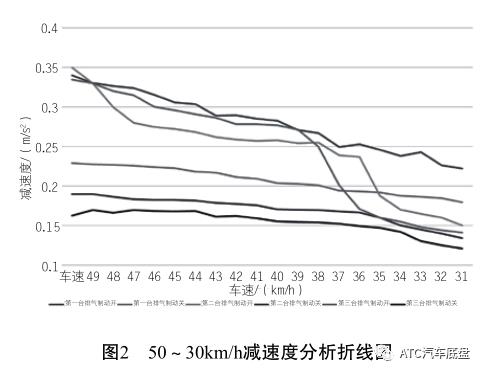

Analysis of the braking force of the three vehicles shows that:
(1) The magnitude and trend of the deceleration caused by engine exhaust braking are basically the same across engines of different power ranges.
(2) When the vehicle is in the speed range of 50-30 km/h, according to normal driving habits while keeping the gear engaged and coasting, without downshifting, the peak deceleration is about 0.3 m/s², and the deceleration decreases as the vehicle speed decreases.
(3) When the vehicle is in the speed range of 30-20 km/h, according to normal driving habits while keeping the gear engaged and coasting, without downshifting, the peak deceleration is about 0.45 m/s², and the deceleration decreases as the vehicle speed decreases.
Summary
Exhaust braking, as an auxiliary braking method, can effectively reduce vehicle speed. Under the condition of not changing gears, during the process of gradually reducing speed, the effectiveness of exhaust braking decreases with the decrease in speed; the exhaust braking effect in low-speed gears is greater than that in high-speed gears. Therefore, in actual driving, if exhaust braking is needed, downshifting should be performed according to the actual vehicle speed to achieve the best effect of exhaust braking.

Focus on the research and development of automotive brake systems and pneumatic brake valves to promote the development of the auto parts industry!
Contact Information
Telephone:86-575-87438928
Mobile:8613252110178
QQ:1185450863@qq.com
Address: No. 461, Advanced Village, Fengqiao Town, Zhuji, Zhejiang Province
Online message
Submit your information and we will contact you as soon as possible.