


26
2026
-
10
Understand and flexibly use winter driving braking knowledge
With snow covering everything in a white blanket, when I was at university, I met classmates who specifically applied to northern schools just to experience the winter scenery. I have to say, the ice and snow in winter bring a different kind of beauty and fun, something most people in the south can't experience.

But for most drivers, especially truckers, winter ice and snow can be deadly; one slip can lead to a lifetime of regret. So, what should you pay attention to when driving in winter? ● Keep the ABS/ASR systems on regularly ABS and ASR stand for "Anti-lock Braking System" and "Traction Control System" respectively. The former prevents the wheels from locking during braking, allowing the truck to get as much braking force as possible while keeping it controllable in emergencies. The traction control system applies brakes to slipping wheels (single-sided slip) or reduces power output (both drive wheels slipping) when starting to avoid wheel spin, ensuring the truck has the necessary traction. The state now requires large trucks to come with ABS, and some high-end domestic tractors are also starting to be equipped with ASR.

Normally keep ABS and ASR always on
Under regular conditions, both should remain on, but special situations require special handling. When a truck needs to brake suddenly on soft ground, turning off ABS allows the wheels to lock and dig into the mud, which can provide greater braking force than keeping the wheels rolling on the mud. When a truck starts on relatively muddy terrain, the wheels may slip due to the sticky mud, but this still provides driving force. If ASR intervenes at this point, it can actually reduce the driving force. You can open the differential lock and turn off ASR in this case.
● Water spraying device Effective but has drawbacks
Without auxiliary braking devices like retarder or engine braking, a truck going downhill can only rely on the brake system. However, frequent braking can cause the brakes to overheat, leading to brake fade and potential accidents. An effective method recognised by many is to install a water spraying device on the brakes. Turn on the water spraying device when entering a downhill section to cool down the brake system.

The water spray system might cause the moving mechanism to move poorly or even fail due to rust. However, there are several major drawbacks of the water spray system that cannot be ignored. Firstly, prolonged use of the water spray system can cause some brake system actuators to rust, resulting in poor mechanism movement or complete failure, and issues like return springs failing, which can prevent the brakes from returning. Moreover, more dangerously, in winter the water pipes of the spray system may freeze, leading to poor water flow, inability to cool the brake system, or spilled coolant freezing on the road, endangering other vehicles.● Try to use auxiliary brakingFinding ways to lower the brake system temperature is only a temporary fix. More and more trucks are now equipped with exhaust brakes, engine brakes, hydraulic retarders and other auxiliary braking devices, also known as frictionless driving brakes, which can be used continuously on long downhill sections without causing brake system heat fade, greatly improving driving safety.

● Avoid fishtailing and use trailer brakes sparinglySome truckers might use the trailer brake in certain situations to prevent the truck from pushing forward, but this isn’t safe. The trailer brake is a type of parking brake and cannot control the braking force like the foot brake. Using it directly might avoid the push-forward effect but could lock the trailer wheels, leading to fishtailing and loss of control. So it’s better to use the foot brake first.

Use the truck brakes more and the trailer brakes less. Moreover, it's also recommended that truck drivers install ABS anti-lock braking systems on their trailers. This not only improves braking quality and makes driving safer but also saves tyre wear, which is a win-win. Stay calm to be able to regain control. When driving on the motorway, factors like black ice can cause skidding and tail slides. Most drivers tend to jerk the wheel to correct the direction, but this is actually more dangerous. No matter how fast we turn the steering wheel, it’s hard to match the skidding truck’s change of direction. Often, by the time the wheel is corrected, the steering direction is already wrong, and it’s hard to adjust it in time, causing the truck to veer in another direction.
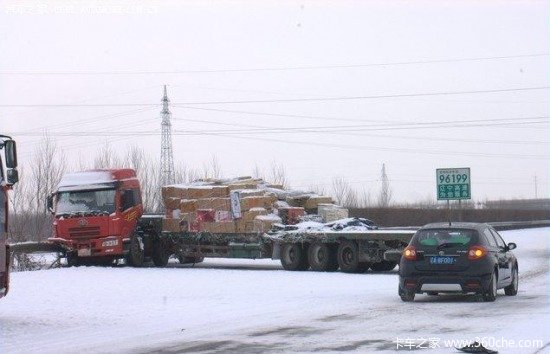
So the right approach is not to jerk the steering wheel, but to try to keep it steady and let the truck stop or stabilise itself as much as possible.
● Try to use guardrails or slopes to gain braking force
No matter how careful we are, unexpected situations always occur on the highway, especially on icy or snowy roads where the braking system often cannot stop the truck in time. In such cases, a clever driver will try to let the truck scrape against guardrails, embankments and other objects to provide extra resistance and help reduce speed faster. After all, the truck can be repaired and you can start over, but if something happens to a person, it could be irreversible.
● Editor's note:
With the follow-up of national policies and the improvement of domestic vehicle technology, devices like ABS and engine brakes are beginning to arm our trucks, greatly enhancing safety. If we develop reasonable driving habits and use these new technologies correctly, ice and snow will no longer be dangerous.
Previous Page
Previous Page

Focus on the research and development of automotive brake systems and pneumatic brake valves to promote the development of the auto parts industry!
Contact Information
Telephone:86-575-87438928
Mobile:8613252110178
QQ:1185450863@qq.com
Address: No. 461, Advanced Village, Fengqiao Town, Zhuji, Zhejiang Province
Online message
Submit your information and we will contact you as soon as possible.