


05
2026
-
09
Why does the clutch have claws?
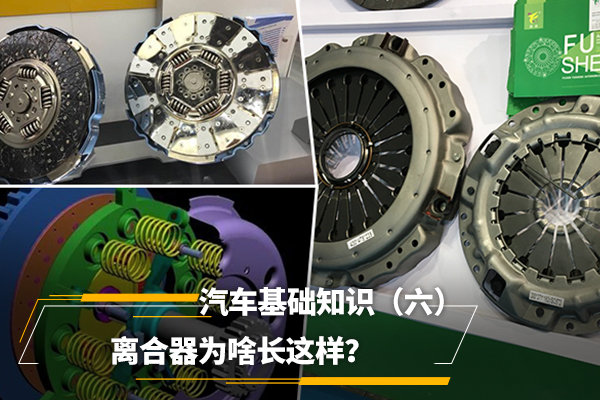
● The Development of Clutches
Early car clutches actually came from other mechanical devices. Some sources indicate that the first generation of clutches was a flat belt (I personally guess it was the centrifugal clutches used on small motorcycles). However, belt transmission was very inefficient and suffered heavy wear, especially in the rain, when power transfer became more prone to problems. As gearboxes added more gears, clutches had to handle even greater torque, so people invented all kinds of clutches, including the predecessor of modern clutches—the friction-based clutch.

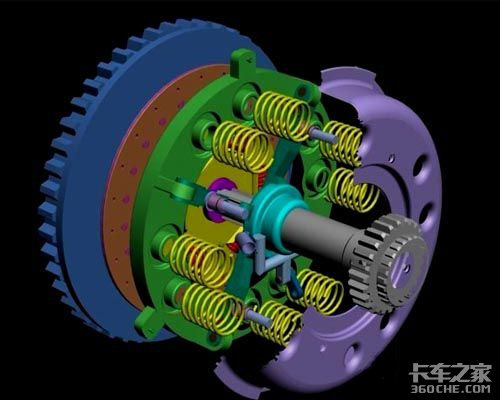
Since the clutch needs to switch between disengaging and engaging, springs are definitely an essential component. Truck drivers with more experience know that old truck clutches used to use coil springs, some placed in the centre, others around the outer edge. But now, clutches don't have these springs; instead, they use a set of plates with claws.
"
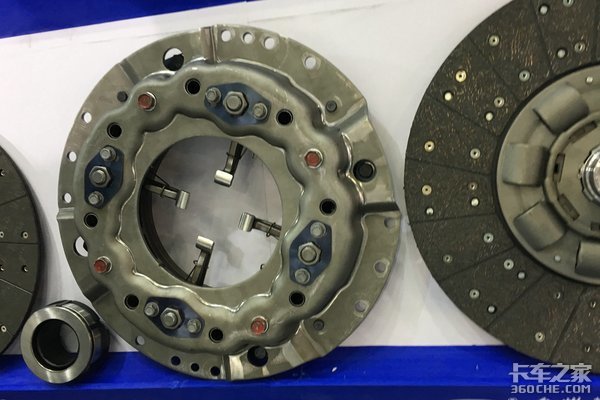
In recent years, diaphragm spring clutches have come to fully meet the needs of domestic heavy, medium, light, sedan, micro and agricultural vehicles. So, why use a diaphragm spring instead of a coil spring?
● Diaphragm spring—more comfortable and reliable
As everyone knows, the tighter a coil spring is compressed, the greater the spring force—meaning the deeper you press the clutch pedal, the harder it is. But a diaphragm spring is different. Its spring force is greatest when deformed to a certain extent, and if it deforms further, the force actually decreases—so pressing the clutch pedal deeper doesn’t necessarily make it feel heavier.

For overloaded vehicles, obviously, the coil spring can provide greater elasticity to press the clutch disc and ensure power output. But for standard-load vehicles, excessive elasticity isn't necessary. In this case, if the loading point of the diaphragm spring is chosen well, it can ensure sufficient clamping force while making the clutch pedal lighter and easier to press, reducing driver fatigue. At the same time, for coil spring clutches, as the friction disc wears and becomes thinner, the spring deformation will definitely decrease, so the clamping force will gradually reduce as well. However, for diaphragm springs, it will first increase and then decrease. (High alert: The red text below is a detailed explanation; if it gives you a headache, best to skip it)
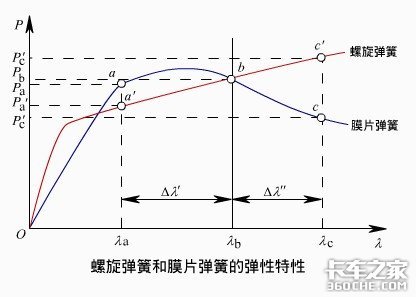
For example, in the picture above: when the clutch is installed, the spring is compressed at position b; when the clutch is pressed, the spring is compressed to position c; after some wear, the spring returns to position a, at this point: For a coil spring: the force to press the clutch pedal becomes heavier; after the clutch disc wears, the clamping force decreases. For a diaphragm spring: the force to press the clutch pedal becomes lighter; after the clutch disc wears, the clamping force actually increases. Therefore, a diaphragm spring clutch is more comfortable and more reliable compared to a coil spring. ● The commonly used clutch in modern heavy trucks - single-plate push-type diaphragm spring clutch In the previous article, we mentioned that in the past, heavy truck clutches used two friction plates, that is, dual-plate clutches, to transmit greater torque. But two friction plates could easily cause incomplete separation, so in recent years, with advances in material technology, heavy trucks have gradually switched to single-plate clutches.
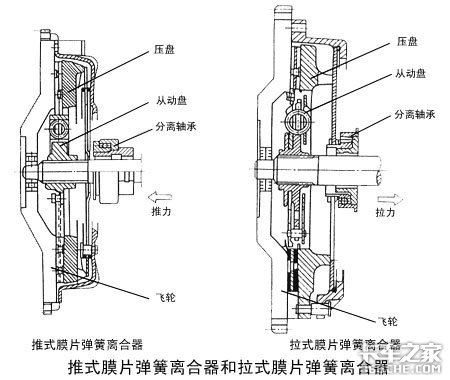
Also, for those who have taken apart a clutch, you might have seen that some clutches separate when the release bearing presses the 'fingers' in the middle of the clutch, while others require the release bearing to pull the 'fingers' out. These are actually two types of clutch structures: pull-type and push-type clutches. The fingers of a pull-type clutch taper inward, while those of a push-type taper outward.

Due to structural issues, with the same pressure plate size, a pull-type clutch can use a diaphragm spring with a larger diameter to provide greater clamping force and transmit more torque; or, under the same torque transmission, it can use a smaller size. Therefore, the pull-type diaphragm spring structure is more compact, with more obvious advantages.
● To summarise: several types of clutches
After all that, many people might be a bit confused, so let's summarise. Clutches can be divided into these categories:
1) By the number of driven discs, clutches can be single-disc, dual-disc, or multi-disc;
2) By the type of spring, clutches can be cylindrical coil spring clutches, conical coil spring clutches, or diaphragm spring clutches;
3) By the arrangement of springs, coil spring clutches can be classified into radial spring clutches or central spring clutches;
4) By the direction of force, clutches can be push-type or pull-type.
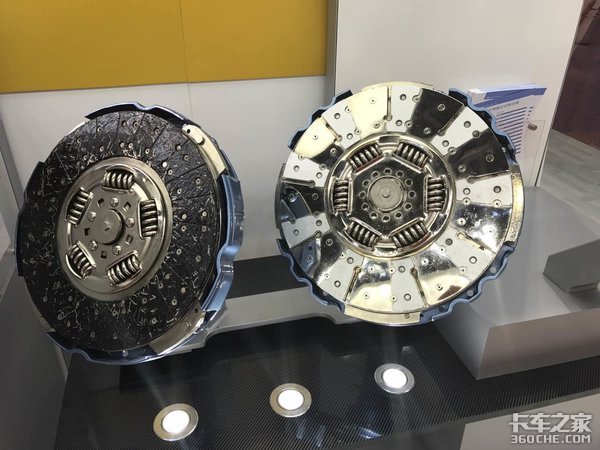
Nowadays, foreign clutch brands like Eaton and Valeo have a very high installation rate in the domestic heavy truck sector, while domestic brands such as Tieliu, Changchun Yidong, and Sanhuan also hold a good market share. Additionally, with continuous improvements in material technology, new types of clutches keep emerging. For example, in 2017, Eaton launched a "ceramic clutch" specifically for the harsh conditions of heavy trucks.
Previous Page
Previous Page

Focus on the research and development of automotive brake systems and pneumatic brake valves to promote the development of the auto parts industry!
Contact Information
Telephone:86-575-87438928
Mobile:8613252110178
QQ:1185450863@qq.com
Address: No. 461, Advanced Village, Fengqiao Town, Zhuji, Zhejiang Province
Online message
Submit your information and we will contact you as soon as possible.