


01
2026
-
09
The world beneath the steering wheel

Starting from this episode, we are going to talk about the last system of the car chassis, the steering system
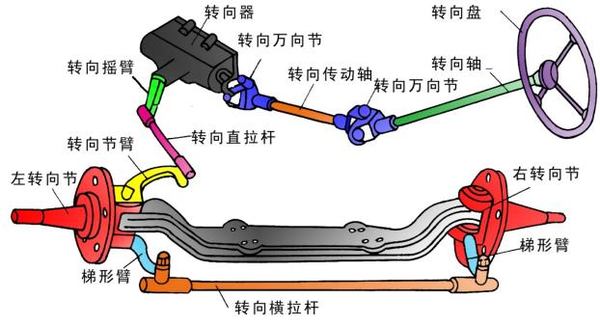
Steering system, as the name suggests, is the system that allows the vehicle to steer. With it, you can turn wherever you want, like into that little alley around the corner, hehe

This system mainly consists of three major parts: the steering control mechanism, the steering gear, and the steering transmission mechanism. In other words, in front of the steering gear is the 'control mechanism', which includes the steering wheel, steering shaft, universal joint, etc. Below the steering gear is the 'transmission mechanism', which includes the steering rod, steering knuckle arm, steering knuckle, etc.

The control mechanism is responsible for analysing your little thoughts and then passing them on to the steering system. Once the steering system receives this signal, it acts like a big butler, wielding a little whip to urge the transmission system to take action and guide you to the alley you want to go to. Generally speaking, experienced drivers evaluate a car's steering system mainly based on the following aspects: 1. Responsiveness 2. Lightness 3. Proper "road feel" 4. Reliability 5. Tyre-friendliness It's worth noting that the first three indicators don't necessarily need to be as high as possible; the main thing is that they are "appropriate". For example, the "play" in the steering wheel may reduce responsiveness but also helps to absorb road shocks, making driving less tiring. That's why many racing cars focus heavily on responsiveness, while ordinary vehicles need a certain amount of "play".

"Lightness" and "road feel" are a bunch of contradictions.
What? You don't know what road feel is?
Road feel is when the condition of the road is transmitted back through the wheels to the steering wheel.
For example, when you go over a pothole, the steering wheel shakes a bit.
After turning, the steering wheel straightens up.
These are all manifestations of road feel.
If the steering wheel is light, the force feedback from the road will naturally be light too.
The straightening force after turning will also be smaller.
High-speed stability will be a bit worse.

But for the sake of comfort, truck steering systems are now developing towards 'lightness'. Reliability is relatively easy to understand. So, what does 'not wearing tyres' have to do with the steering system? Careful truck friends might notice a magical secret: when turning, the angles that the two front wheels turn are actually different! (Shocking!) (Is it a stubborn twist? (Or a moral decay?))

Why is that? In theory, when a vehicle turns, all the wheels should rotate around the same centre. This way, it can avoid tyre wear. So, when turning, the inside wheels should turn at a greater angle than the outside wheels, and they should follow a certain function relationship.

But in reality, existing types of steering mechanisms cannot completely guarantee this relationship, so technically, the problem of wheel slip cannot be entirely eliminated. Especially for double-drive axle trucks, tyre wear is inevitable. Therefore, twin-steer trucks save more tyres compared to dual-drive trucks. In addition, many manufacturers have introduced rear-wheel steering trucks to make the wheels fit the path better and reduce tyre wear.
 不过!
不过!
There's an even bigger mastermind behind the tyre issues. We won't talk about it in this episode. We'll leave it for the next one, so everyone can catch the culprit with me. At the end, I also want to recommend the latest development direction of the transformation system, which is electrification. For example, Volvo's dynamic steering system.

This system adds an electric control motor to the traditional mechanical steering system to help with steering
At low speeds, this system becomes really light, and at high speeds, the steering focuses more on stability. The motor can also automatically adjust the steering, compensating for crosswinds or uneven roads. It's like having an experienced driver helping you control the direction, which is why they can take on challenges like this:
Besides that, this system can also prevent skidding in advance, prevent lane departure, adjust steering wheel damping, and more. It has really powerful features
Do you have an urge to buy a Volvo? Alright, that's it for today. I hope everyone can not only drive a Volvo truck but also a Volvo car. (Bros driving a Lamborghini, step aside, not talking to you)

Focus on the research and development of automotive brake systems and pneumatic brake valves to promote the development of the auto parts industry!
Contact Information
Telephone:86-575-87438928
Mobile:8613252110178
QQ:1185450863@qq.com
Address: No. 461, Advanced Village, Fengqiao Town, Zhuji, Zhejiang Province
Online message
Submit your information and we will contact you as soon as possible.