


21
2026
-
07
When the 'clutch' meets 'double'

In a car's transmission system, there’s a concept called the 'dual-clutch automatic transmission.' Besides this, you might have also heard of the 'dual-plate clutch' or 'dual-mass flywheel clutch.' All three terms have the words 'dual' and 'clutch,' but they refer to completely different components.
● Dual-plate clutch — two friction plates
A dual-plate clutch is basically a clutch that has two friction plates.
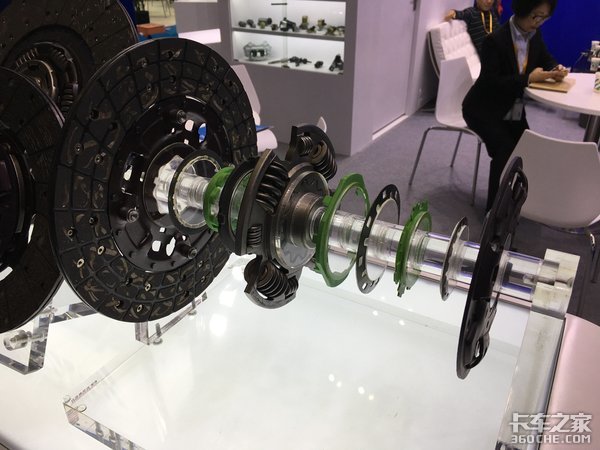
Everyone knows that a clutch is made up of the pressure plate, friction disc (also called the clutch disc), and release bearing. When it’s working normally, the pressure plate and engine flywheel squeeze the clutch disc, transferring power to the clutch disc, which then passes it on to the gearbox input shaft.

Obviously, the torque that a clutch can transmit is limited by its size. So if you want to break through this limit, you need to add a friction disc and also a pressure plate between the two friction discs.
Some early heavy-duty trucks used this kind of setup. But dual-plate clutches have relatively poor heat dissipation and can also have issues with incomplete disengagement. Nowadays, with advancements in material technology and less overloading, almost all vehicles use a single-plate clutch.
● Dual-Clutch Transmission — Two Clutches
A dual-clutch transmission is a gearbox that comes with two clutches.
In simple terms, one clutch is connected to the gearbox’s odd-numbered gears (1, 3, 5, 7, etc.), and the other clutch is connected to the even-numbered gears (2, 4, 6, etc.). This way, when you accelerate in 3rd gear, the gearbox can already pre-select 4th gear and 'press down' the clutch for 4th. When it’s time to shift, you 'press down' the 3rd gear clutch and 'release' the 4th gear clutch, and the shift is done.
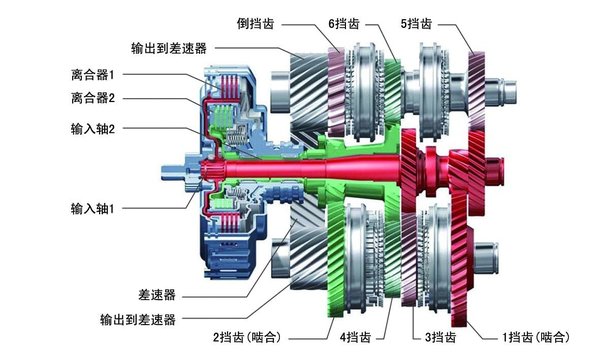
Dual-clutch transmissions were initially used in racing cars because of their excellent shifting speed. Since shifting is faster, the engine idling time is reduced, which leads to better fuel efficiency. So over time, they gradually made their way into passenger cars.
In recent years, some foreign companies like Daimler, Eaton, and Volvo have also started introducing their dual-clutch products in the commercial vehicle sector.
● Dual-mass flywheel clutch — the flywheel is split into two parts
For those who've taken apart a clutch before, you know that there’s a set of springs in the middle of the clutch disc called a 'torsional damper.' When the clutch engages, it acts as a buffer, making the vehicle start more smoothly.
But since the primary job of the clutch is to transmit power, and the torsional damper is quite small, the springs are generally pretty stiff—they can only help dampen vibrations to some extent when starting off. When the car is idling, the engine vibrations are passed to the transmission through the flywheel and clutch, and due to the 'resonance' effect, the car can shake quite noticeably, which I think everyone has experienced.
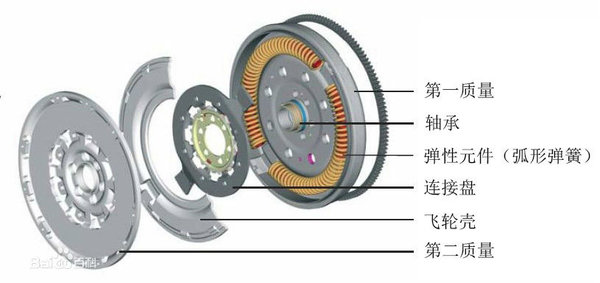
To deal with this situation, automotive engineers decided to take out this torsional damper and place it next to the flywheel. This way, it wouldn't be limited by the clutch plates, allowing them to make it a bit bigger and make the spring a little softer. They also split the flywheel into two parts and connected them with this spring. That way, the engine's power first goes through the first mass, then through the torsion spring, then through the second mass, and finally to the clutch and the gearbox.
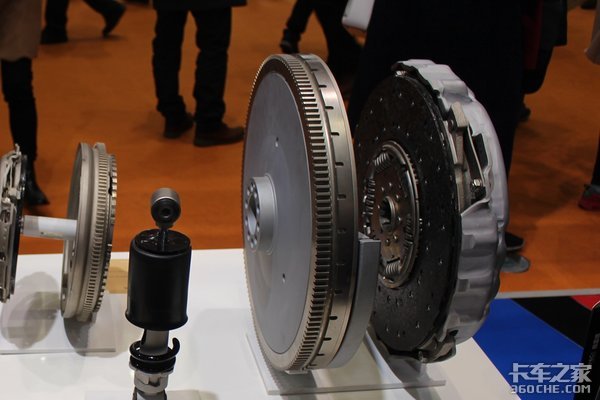
After this layer of filtering, the vibrations mostly stay around the engine, which not only reduces overall noise but also extends the lifespan of the transmission. This effect is even more noticeable for diesel engines with higher torque. According to engineers at ZF, their Sachs dual-mass flywheel clutch can make a diesel car feel just as comfortable as a gasoline car.
Previous Page

Focus on the research and development of automotive brake systems and pneumatic brake valves to promote the development of the auto parts industry!
Contact Information
Telephone:86-575-87438928
Mobile:8613252110178
QQ:1185450863@qq.com
Address: No. 461, Advanced Village, Fengqiao Town, Zhuji, Zhejiang Province
Online message
Submit your information and we will contact you as soon as possible.