


11
2026
-
04
Use your car carefully, drive smoothly, and keep brake failure away from you.
Our country is a mountainous country, and due to the terrain, most of our highways have relatively steep slopes. During daily driving, braking becomes particularly crucial.
● Major Causes of Brake Failure and How to Handle Them
There are many reasons for brake failure. The editor has briefly categorized them as follows.
1. Brake failure caused by insufficient regular maintenance

Neglecting the maintenance of the brake system in daily use can lead to its failure when it is critically needed, potentially causing a major accident.
Solution: Regularly check whether the master cylinder, wheel cylinders, air reservoirs, and pipelines are functioning properly. Any air leaks or poor operational conditions should be repaired or replaced immediately. During driving, always pay attention to changes in the air pressure on the dashboard.
2. Improper operating methods leading to mechanical failure
Due to the driver’s lack of experience, incorrect vehicle operation can cause mechanical failure.
Solution: When driving down long slopes, use a low gear to reduce speed and let the engine control the vehicle's speed, minimizing brake use to prevent brake pad overheating. Apply the brakes intermittently rather than using a "one-step full press" method.
3. Severe overloading causing brake failure

Severe overloading increases the total mass of the vehicle, which, under the action of gravitational acceleration, increases the vehicle's kinetic inertia, directly causing brake failure.
Solution: Overloaded vehicles have increased total mass, thereby increasing their kinetic inertia. When driving an overloaded vehicle, one must drive slowly and should not ignore safety in order to save time.
● Reasonably choose auxiliary brakes to make driving safer
Exhaust brakes have become standard equipment on most cargo vehicles and should be used in conjunction during driving. In addition, we can also choose other auxiliary brakes (such as engine brakes, retarders, etc.), making our driving safer.
● What to do if the vehicle's brakes fail while driving
If the vehicle's brakes fail during driving, how should we handle it? Here are some summarized experiences for reference:
1. Maintain a calm mindset
When we realize that the vehicle's brakes have failed, normal physiological reactions will cause our "heart to race" and our "mind to go blank." Not knowing what to do will only worsen the severity of the accident. At this moment, it is crucial to quickly calm down and think of ways to minimize damage, and definitely not let panic make things worse.
2. Quickly shift gears to reduce speed
Control the steering based on road conditions and vehicle speed, and shift gears according to road conditions and skill level, using engine resistance to slow down the vehicle. (Use caution on very steep roads and for novice drivers!)
3. Scraping, collision. Forcefully stopping the vehicle

To reduce accident damage, use rigid parts of the vehicle such as the bumper and cabin to scrape or collide with guardrails on the roadside or natural obstacles (rocks, large trees, and earth slopes) to forcibly stop the vehicle and escape danger, minimizing accident losses as much as possible.
4. Handling brake failure on an uphill
If brake failure occurs on an uphill, it is necessary to timely shift to a medium or low gear to maintain sufficient power to reach the top of the slope and stop. If stopping halfway up a slope is necessary, keep the vehicle in a low forward gear, and passengers should promptly use stones, wooden blocks, and other objects to block the wheels. If the vehicle still tends to slide backward, the rear of the car should face the hillside or a safe direction, and turn on the headlights and hazard lights to alert the vehicles in front and behind.
5. Handling brake failure on a downhill
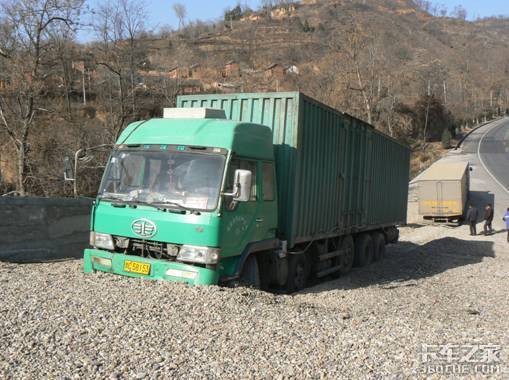
When a vehicle experiences brake failure on a downhill slope and it is impossible to control the speed using the vehicle's own mechanisms, one should decisively use obstacles, escape lanes, or other means to create resistance and bring the vehicle to a stop. After stopping, shift into reverse, with the front of the vehicle facing the safer direction.
6. Habitually check the brakes
During regular driving, especially when going down long or steep slopes, one should habitually press the brakes. This not only tests the brakes' performance but also gains time to control the vehicle if brake failure occurs.
7. Do not take chances; personal safety is paramount
When the vehicle is uncontrollable and an accident is inevitable, personal safety should be prioritized first. Try to minimize damage to other vehicles and oneself, and decisively choose to jump out of the vehicle to ensure the safety of your life.
● Editor's Note:
Brake failure is largely controllable. Avoid careless or speeding driving, be mindful, and stay alert while driving to keep dangers at bay. Everyone is welcome to discuss in the comments.
Previous Page
Previous Page

Focus on the research and development of automotive brake systems and pneumatic brake valves to promote the development of the auto parts industry!
Contact Information
Telephone:86-575-87438928
Mobile:8613252110178
QQ:1185450863@qq.com
Address: No. 461, Advanced Village, Fengqiao Town, Zhuji, Zhejiang Province
Online message
Submit your information and we will contact you as soon as possible.