


24
2025
-
12
Basic Knowledge of Automobiles (Part 1) Overall Structure of a Car
A while ago, in order to systematically learn more about cars, I bought a few books on the subject. After reading them, I found that although the content was relatively simple, the material had been organized in the textbooks very clearly, making it especially easy to study. Therefore, starting today, I plan to create a column to share the knowledge from these textbooks, hoping to help some newcomers quickly get to know their vehicles. Since this is aimed at beginners, the following information may be quite basic, so I hope experienced drivers won’t mind and will offer plenty of feedback and corrections.

The content of this first issue will start with the most basic topic, which is the structure of a car.
There are countless parts in a car, but when someone asks, 'What is a car made of?' many people don't know where to start. Generally, cars are divided into four main parts:
1) Body
2) Engine
3) Chassis
4) Electrical equipment
Next, we will peel back these four parts of a car one by one, like peeling an onion, to take a closer look.
● Body
Let's start with the body. The body is the part of the vehicle used to carry people or goods. It includes the main body (frame), exterior body parts, interior body parts, and electrical accessories of the body. Passenger cars and buses generally have an integral body structure, while trucks usually consist of a cab and a cargo section.

The car body is classified as 'monocoque body,' 'semi-monocoque body,' or 'body-on-frame' depending on whether it carries the chassis structure. For example, in a sedan, the engine, transmission, and other chassis components are directly attached to the car body itself, and the body needs to support their weight, so it is a monocoque body. (Do you know what 'hatchback,' 'two-box,' and 'three-box' mean for a monocoque body?)

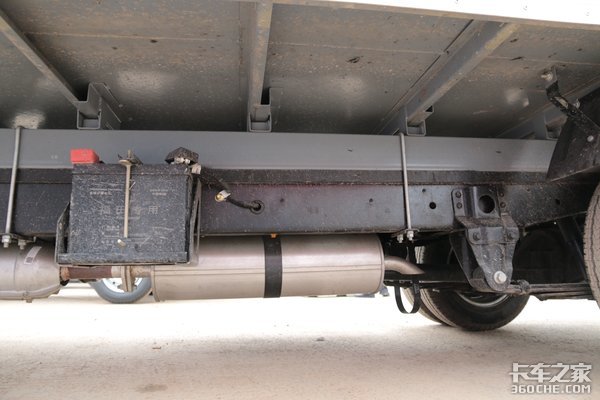
Truck chassis all have separate main beams to support the various assemblies, while the body only bears the load of passengers and cargo. Therefore, it is a non-load-bearing body.
It can be seen that a unibody chassis, because it bears the load of the chassis, has relatively lower load-bearing capacity compared to a body-on-frame chassis. However, due to its compact structure, the vehicle is more integrated, resulting in lower noise and lighter weight, and it is generally used in cars and similar vehicles. On the other hand, a body-on-frame chassis, with its stronger load-bearing performance, is used not only in trucks but also in many rugged off-road vehicles.
● Engine
Once the body is removed, we can immediately spot the heart of the car—the engine.

Although the reviews from various media often categorize the engine under the chassis section, due to the complex structure and principles of the engine, it is often treated as a separate part.
In addition, when we refer to the engine here, it actually includes all its attachments, such as the fuel tank, exhaust after-treatment system, and so on. These can all correspond to the engine’s “five major components” and “two major systems” (which will not be elaborated on in this article).
● Chassis
Excluding the body and engine, the remaining frame (as mentioned earlier, a unibody does not have a separate frame), transmission, rear axle, wheels, etc., all belong to the chassis section.

According to different functions, the chassis can be divided into four major systems: the driving system, the steering system, the transmission system, and the braking system. We will also cover these separately later on.
● Electrical equipment

Electrical equipment mainly consists of the power supply system, electrical devices, and distribution units. As can be seen, electrical equipment is actually embedded within the other three parts, but it acts like a dense network, connecting various mechanisms of the vehicle, while also functioning like a commander, coordinating the work of each part. Therefore, listing this section separately is very important for the overall design of the vehicle.
Previous Page
Previous Page

Focus on the research and development of automotive brake systems and pneumatic brake valves to promote the development of the auto parts industry!
Contact Information
Telephone:86-575-87438928
Mobile:8613252110178
QQ:1185450863@qq.com
Address: No. 461, Advanced Village, Fengqiao Town, Zhuji, Zhejiang Province
Online message
Submit your information and we will contact you as soon as possible.