


20
2025
-
12
It's not about air pressure or oil. What's going on with the clutch booster?
Some trucks, especially medium and heavy-duty ones, have a relatively high clutch pressing force. To reduce the effort required by the driver to press the clutch pedal, a clutch booster is usually used, also called a clutch assist cylinder or assist pump. This device uses both an air cylinder and a hydraulic cylinder, so some truck enthusiasts think it is similar to the principle of air-over-hydraulic brakes. In fact, the principles of the two mechanisms are quite different.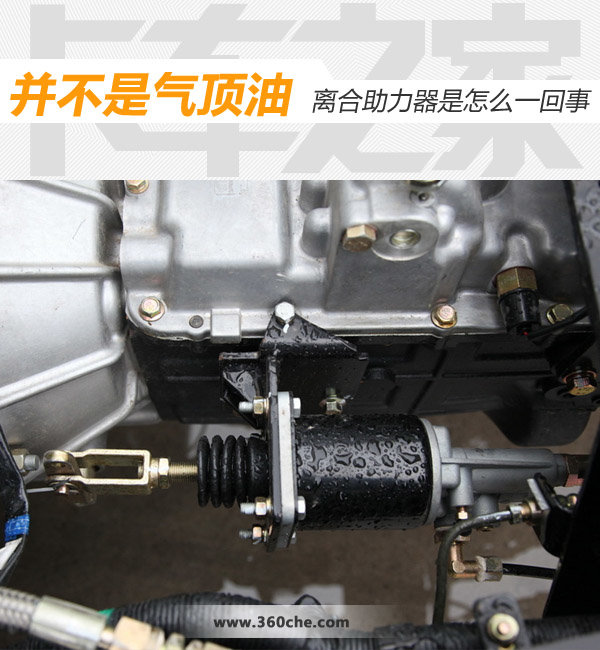
The clutch mechanism uses brake fluid as a medium, starting from the clutch pedal and ultimately transmitting force to the clutch fork, acting on the release bearing, pressing down the diaphragm of the pressure plate to separate the pressure plate and clutch disc, thereby interrupting power transmission.
Common non-assisted hydraulic clutch mechanism:
Pedal → Clutch master cylinder (hydraulic) → Oil pipe → Clutch slave cylinder (hydraulic) → Clutch fork
Clutch mechanism with clutch booster cylinder:
Pedal → Clutch master cylinder (hydraulic) → Oil pipe → Clutch booster cylinder (hydro-pneumatic) → Clutch fork

It can be seen that the clutch booster cylinder replaces the original ordinary clutch slave cylinder, and both serve the same function, which is to control the clutch fork via the push rod. However, in the booster cylinder, a cylinder is introduced to use air pressure to provide assistance.
In terms of structural principle, the clutch booster cylinder is similar to the pneumatic-hydraulic booster cylinders used in industrial manufacturing. It also features an integrated structure of a pneumatic cylinder and a hydraulic cylinder, with hydraulic oil and compressed air kept separate, using compressed air to achieve the boosting effect.

Pressing down the clutch pedal causes the brake fluid from the clutch master cylinder to flow into the oil chamber of the booster cylinder. At this point, the hydraulic oil has two paths: one is to push the master cylinder piston connected to the push rod, and the other is to push the slave piston, opening the cylinder valve, allowing compressed air from the air reservoir to enter the air chamber of the booster cylinder. Under the combined action of air pressure and hydraulic pressure, the push rod is pushed out.
When the clutch pedal is released, the oil pressure drops. Under the force of the clutch pressure plate spring, the push rod returns to its original position. The slave piston also returns simultaneously, closing the air intake channel. At this time, there is an exhaust gap between the valve assembly and the slave piston, allowing the compressed air to be vented to the atmosphere, and the push rod returns to its initial position.

Unlike vacuum-assisted pumps, the clutch booster provides more direct assistance. Additionally, some light truck drivers who want to install a clutch booster need to pay attention to two issues: first, there must be an air tank (essential for air-brake models), and second, there must be enough installation space. On the market, clutch boosters come in cylinder diameters ranging from 70mm to 120mm, but light trucks generally only require a smaller cylinder diameter.
● Editor's Note:
Some might say, wouldn't it be better to use air pressure directly for the clutch? However, if you have used air brakes, you can feel that air pressure control is not very precise, and since the clutch requires semi-engagement control, using pure air pressure is not very practical. In summary, air-over-hydraulic brakes use a series connection of an air chamber and a hydraulic cylinder, with braking executed hydraulically, while the clutch booster cylinder is an air-hydraulic integrated component that uses air pressure to assist. Therefore, a clutch booster cannot be considered the same as air-over-hydraulic.
Previous Page
Previous Page

Focus on the research and development of automotive brake systems and pneumatic brake valves to promote the development of the auto parts industry!
Contact Information
Telephone:86-575-87438928
Mobile:8613252110178
QQ:1185450863@qq.com
Address: No. 461, Advanced Village, Fengqiao Town, Zhuji, Zhejiang Province
Online message
Submit your information and we will contact you as soon as possible.