


06
2026
-
10
It's not about the gas hitting the oil, what's going on with the clutch booster?
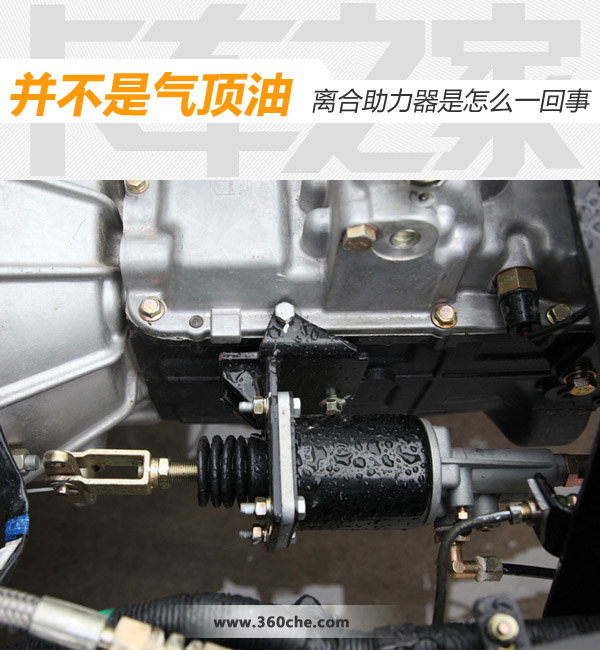
The clutch mechanism uses brake fluid as a medium, starting from the clutch pedal and eventually transferring force to the clutch fork, acting on the release bearing, pressing down the diaphragm of the pressure plate to separate the pressure plate and clutch disc, and interrupting the transmission. A standard non-assisted hydraulic clutch system: Pedal—Clutch master cylinder (hydraulic)—Oil pipe—Clutch slave cylinder (hydraulic)—Clutch fork Clutch system with an assisted cylinder: Pedal—Clutch master cylinder (hydraulic)—Oil pipe—Clutch assist cylinder (hydraulic-pneumatic integrated)—Clutch fork

As you can see, the clutch booster cylinder replaces the original ordinary clutch slave cylinder, but both serve the same purpose, controlling the clutch fork via the pushrod. However, the booster cylinder introduces a cylinder that uses air pressure to provide assistance. Structurally, the clutch booster cylinder is similar to the pneumatics-hydraulics booster cylinders used in industrial manufacturing. Both combine a cylinder and an oil cylinder, keeping hydraulic oil and compressed air separate, and use compressed air to provide assistance.

Press the clutch pedal, and the clutch master cylinder's brake fluid output reaches the booster cylinder's fluid chamber. At this point, the hydraulic oil has two paths: one pushes the master cylinder piston connected to the push rod, and the other pushes the slave piston, opening the cylinder valve so that compressed air from the air tank enters the booster cylinder's air chamber. With both air pressure and fluid pressure acting together, the push rod is pushed out.
Release the clutch pedal, and the oil pressure drops. Under the action of the clutch pressure plate spring, the push rod moves back to its original position, and the slave piston also returns at the same time, closing the intake channel. There is an exhaust gap between the valve assembly and the slave piston, allowing the compressed gas to vent to the atmosphere, and the push rod returns to its original position.

Unlike a vacuum booster, the clutch booster provides more direct assistance. In addition, some truck drivers who want to install a clutch booster in their light trucks need to pay attention to two things: first, a compressed air tank is required (mandatory for air-brake vehicles), and second, there needs to be enough space for installation. On the market, clutch boosters come in cylinder diameters ranging from 70mm to 120mm, and light trucks generally only need small-diameter ones.
● Editor's note:
Some might say, wouldn't it be better to use air pressure directly for the clutch? But from using air brakes, you can feel that the controllability of air pressure is not great, and the clutch requires half-engagement control, so using pure air pressure isn't very practical. To summarise, air-to-hydraulic brakes operate via a series connection between the air chamber and the hydraulic cylinder, with hydraulics executing the braking; while the clutch booster is air-liquid integrated, using air pressure to assist, so in this sense, clutch assistance cannot be called air-to-hydraulic.

Focus on the research and development of automotive brake systems and pneumatic brake valves to promote the development of the auto parts industry!
Contact Information
Telephone:86-575-87438928
Mobile:8613252110178
QQ:1185450863@qq.com
Address: No. 461, Advanced Village, Fengqiao Town, Zhuji, Zhejiang Province
Online message
Submit your information and we will contact you as soon as possible.