


25
2026
-
08
Solve the brake maintenance problem and hope all truckers get home safely
Experienced drivers who are on the road all year round know that maintaining the brake system is crucial for the safety of driving. Car brake systems are usually divided into two types: hydraulic brakes and air brakes. Because their braking structures and operating principles are different, the methods for brake maintenance are also quite different.

▎Hydraulic brakes
Hydraulic brakes are simple in structure and compact in size, only needing a master cylinder, slave cylinders, a brake fluid reservoir and the connecting pipes, without any other auxiliary equipment. Hydraulic brakes have features like slightly slower response, smooth braking and lower force, so they are generally used in light trucks.
The principle of hydraulic braking: when we press the brake pedal, the force is transmitted to the master cylinder, which works like a syringe filled with brake fluid. When the force is applied, the piston pushes the brake fluid forward. The fluid travels through the brake lines to the slave cylinders at the four wheels, which then push the brake pads to clamp the brake discs and achieve braking.

For cars with hydraulic brakes, check the brake fluid level before driving. If you notice the fluid level has dropped, immediately check for any leaks in the brake lines. Brake fluid can absorb moisture from the air and lose effectiveness over time, so it's best to replace it every year.
▎Air Brakes
Compared to hydraulic brakes, air brakes are much more complicated. Aside from the master cylinder, wheel cylinders, and brake lines, there is also an air compressor (connected to the engine by a belt), air reservoir, high-pressure controller (regulates pressure, up to 8 atmospheres for vehicles), and relay valves, among other components. They require more installation space and have a more complex structure. For safety, the rear wheel cylinders now use air-cut brakes (increasing cost and complexity). Furthermore, because air brakes respond quickly, brake abruptly, and have strong force (air pressure can reach 8 atmospheres), they are mostly used on large trucks and buses.

Air brake principle: When we press the brake, it is like opening the master pump valve (all are one-way valves, allowing air in but not out). Compressed air enters the rear brake spring cylinder through the one-way valve, pushing the brake arm. The brake cam rotates, expanding the brake shoes (now mostly asbestos with a bit of copper wire) to press against the brake drum (cast iron), achieving braking. Nowadays, double-circuit, cross-brake piping systems are used to ensure that even if one part of the circuit leaks, there is still braking.
● Checking and replacing brake pads and brake discs
For trucks, especially when loaded, the mass and inertia are large, creating more force on the brake pads during braking and generating more heat. Most brake failures occur because brake pads overheat from continuous use, so maintaining the brake pads and discs is very important.

Brake pads and discs are wear parts, and their wear depends on the driver's braking habits and road conditions. You can tell by checking the wear on the truck's brake pads, and if they're at the critical point, they need to be replaced immediately. The main maintenance for brake pads includes high-temperature protection, lubrication of the brake calipers, and cleaning the brake discs.

Uneven Brake Pad Wear
Just like brake pads, brake discs also need replacing only when they have worn down to the limit. Generally, when you change three sets of brake pads, you also need to replace the brake discs. Brake discs go through frequent use, generating high temperatures due to friction, and in severe cases, they can even get burnt to a brick-red colour. At this point, some drivers might think of cooling them with water, but this actually causes significant damage to the brake discs.
● Low-Quality Drying Tanks Pose Serious Risks, Avoid Them!
Everyone is familiar with drying tanks; they filter water vapour from the compressed air in the system, preventing tanks and various pumps and valves from corrosion. Therefore, whether a drying tank works properly directly affects braking performance. Drying tanks aren’t expensive, but many truck drivers tend to save money and don’t care much about the quality, thinking it’s enough as long as one works, and some don’t even replace them for years.

Drying tank installed in the air circuit
Some truck drivers trying to save money can easily fall into the trap of fake drying tanks. Currently, the price of genuine drying tanks in the market is generally around 200 yuan, while poor-quality products are usually sold for less than 100 yuan, and wholesale prices can be as low as 20-30 yuan. These low-quality drying tanks lose their ability to absorb moisture from the air after a short period of use, and the desiccant in some tanks can even enter the vehicle's air system, causing greater safety and financial risks. A friend once shared their personal experience: while driving in Heilongjiang, a low-quality drying tank failed, causing water to freeze in the brake caliper and resulting in brake failure. Choosing a high-quality drying tank in the cold winter has become quite a skill.

Fake 'Relative' Drying Canister
Also, when choosing a drying canister, we should try to select those with fine and numerous air vents and a stronger structure. Many drying canisters on the market have air vents with a relatively large diameter. At first glance, this design doesn't seem problematic, but if thinner filter paper and smaller desiccants are used, the larger pressure in the vehicle's air circuit can easily push the internal desiccant out, directly entering the air circuit, causing blockages and safety hazards.
The lifespan of a drying canister is greatly related to the usage environment. Generally, when the furthest air reservoir from the air compressor starts to release water, it indicates that the drying canister is nearing failure and should be replaced immediately.
● Winter air routes have water How to avoid?
In winter, various braking issues frequently occur, and problems in the air circuit are often the most overlooked by truck drivers. Many times, air at normal temperature is heated when passing through the air pump and gradually cools down as it moves through the pipes. During cooling, moisture in the air condenses into liquid, so water in the pipes during winter can cause multiple issues. In this situation, the drying canister becomes even more important. If the drying canister fails, excess moisture in the air circuit can freeze, blocking the air paths, causing brakes to be unresponsive or even fail, leading to accidents.

On the other hand, winter is dry and cold, and many air pipelines can become very brittle, easily developing cracks or even breaking. If there is a leak, it can prevent the air pressure from reaching the set value, causing brake failure and stopping the drying tank from regenerating.
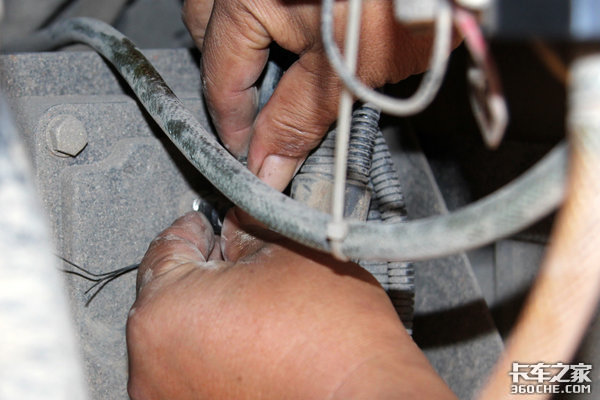
Therefore, before driving, carefully check whether the air hose connections are aging or cracked, and replace them promptly if any issues are found. Next, keep spare hoses and quick connectors during driving so that they can be immediately replaced or repaired in case of an air line break. Because the air lines are spread over a large area, they inevitably come into contact with the chassis or other parts. If the contact points experience frequent friction, it will accelerate damage to the pipes, so check regularly and wrap the areas where the pipes are scattered to prevent faster deterioration.
● The air pump, often overlooked, holds great importance
The air pump is the source of air pressure for the entire vehicle, especially crucial for braking. In regular maintenance, the air pump is also one of the easily neglected parts. Without proper care, it can suffer abnormal wear, oil leaks, and oil consumption, which in severe cases can introduce water or oil into the air lines, affecting the vehicle's braking performance.

Nowadays, air pumps generally take air from the intake pipe and then compress it into the air tank. Using poor-quality air filters or letting the air pump's intake pipe work on its own can easily let debris into the pump, causing abnormal wear. This wear mainly affects the pump cylinder, piston rings, and the pump shaft bearings. Long-term exposure to unclean air can cause severe cylinder wear, increase the diameter, thin out piston rings, and reduce oil lubrication among other problems. In more serious cases, it can lead to oil contamination, where oil is sucked into the air tank during compression, affecting braking performance and consuming oil.

Scale forms inside the air pump
Some air pumps use engine coolant for cooling, similar to how the engine block works. Some drivers use water instead of antifreeze in daily use, which causes scale to build up inside the pump, blocking water passages and affecting its cooling. Therefore, for air pump maintenance, it's recommended for drivers to use high-quality air filters and antifreeze, and not let the air pump intake run independently.
During driving, the normal functioning of the braking system is very important. If it fails, the driver's safety is at serious risk. So, when maintaining brakes, drivers should pay extra attention! With the New Year approaching, I hope every driver out there can get home safely and reunite with their wife and kids.

Focus on the research and development of automotive brake systems and pneumatic brake valves to promote the development of the auto parts industry!
Contact Information
Telephone:86-575-87438928
Mobile:8613252110178
QQ:1185450863@qq.com
Address: No. 461, Advanced Village, Fengqiao Town, Zhuji, Zhejiang Province
Online message
Submit your information and we will contact you as soon as possible.